
Coaches Hub
Messy Is Good: Why Decisions, Not Drills, Develop Players
· @DaveRimmer
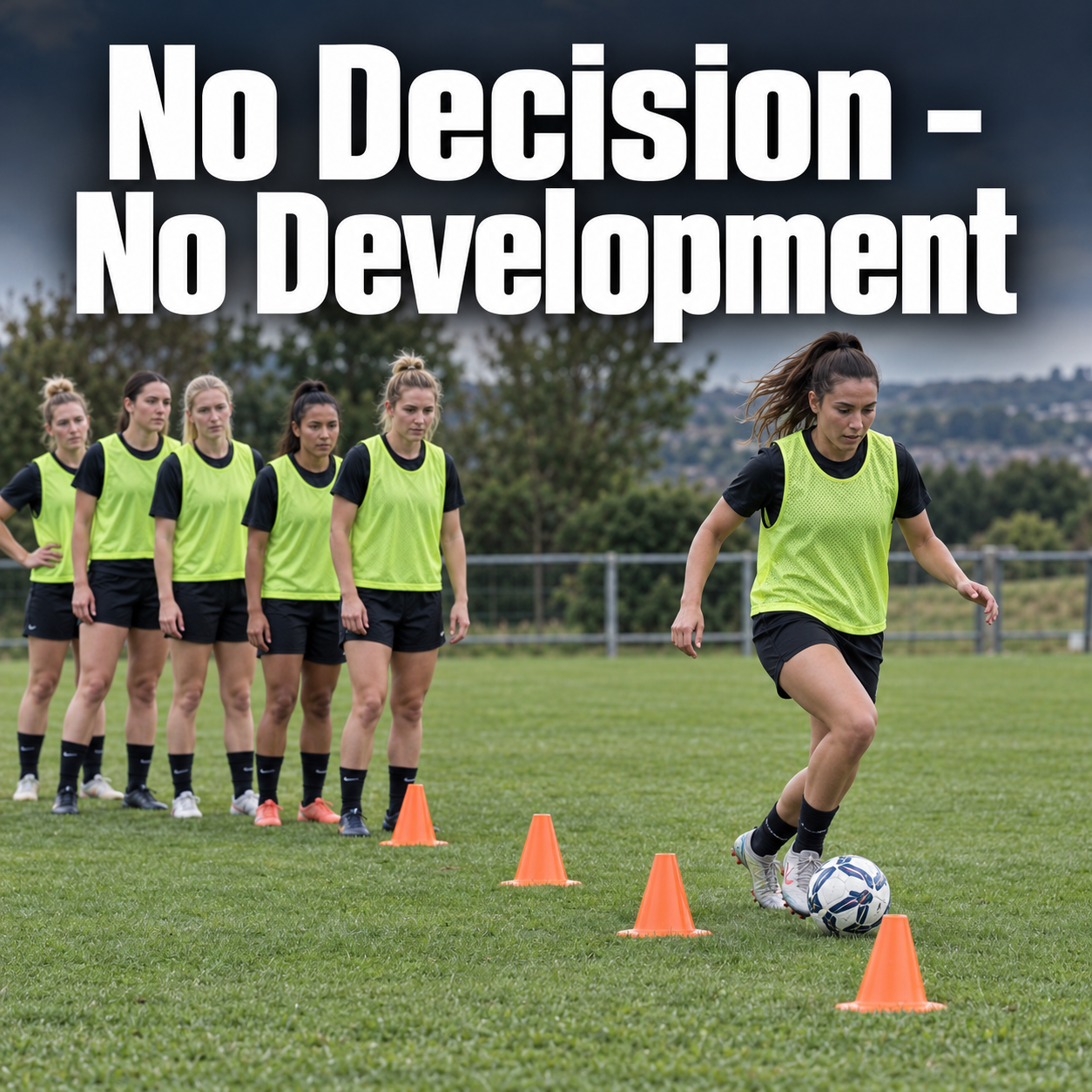
I see lots of grassroot raining sessions all looking similar. Neat lines of players. Cones laid out perfectly. Balls zipping into an empty net. It looks organised, and it looks like good coaching.
Now walk past a session where the ball is being lost, players are bumping into each other, passes are going astray and the coach is standing back saying very little. It looks messy. Some parents might even think the coach doesn't know what they're doing.
In my opinion, the second session is often the better one.
Here's why.
The game is messy, so training should be too
Football is chaotic. Twenty two players, one ball, constant movement, and nothing ever happens the same way twice. Every second, players are scanning, reading and choosing what to do next.
If training is going to prepare players for that, it has to look like the game. That means practices will often look chaotic, especially while players are in the learning phase. They will get things wrong. The ball will go out of play. Moves will break down.
That's not a sign the session has failed. That's what learning looks like. Tidy is not the goal, transfer to the game is.
Count decisions, not goals
So how do we judge whether a session was any good? It isn't the number of goals scored. It isn't the number of tackles made. It isn't even the number of touches of the ball.
In my opinion, a good training session is measured by the number of decisions each player had to make.
A player can have a hundred touches in a session and make almost no decisions. Another player can have thirty touches and make a decision on every one of them, plus dozens more off the ball about where to move, when to press and when to hold. The second player has had the better session.
No problem, no decision
Here's the key point, a decision can only be made when a player is faced with a problem that needs a solution.
A defender closing you down is a problem. A teammate making a run you didn't expect is a problem. Two passing options and a split second to choose is a problem. Take the problem away and you take the decision away with it.
Once a player has found a solution, the job isn't to give them the exact same problem over and over. It's to give them a similar problem, but slightly different, so they have to find a similar solution that's still slightly different. The defender comes from another angle. The space is a bit tighter. The support arrives a second later.
This is repetition without repetition. The player keeps practising the same idea, but never in quite the same way, which is exactly how they'll meet it on match day.
Where the decisions go missing
With that in mind, look again at some of the most common practices in football.
Players queuing behind cones. Every second a player spends standing in a line waiting for their turn is decision making time they're losing. How many players do you see standing in lines in a game? None.
Dribbling through cones. Is the player making a decision? Are they overcoming a problem with a solution? The cones don't move, don't press and don't read their body shape. The answer is the same every single time.
A 1-2 and a shot into an empty net. Pass, return, finish, unopposed. Is there any decision being made, or any problem being solved? The player knows exactly what's coming before they start.
None of these practices are useless, but none of them develop the thing that matters most in the game. A training session that isn't full of decision making moments will never develop a player.
Get the level of stress right
This doesn't mean throwing every player into a full pressure game from day one. The complexity of the solution needed, and the amount of stress put on a player, should match their level and experience. A beginner might need more time and space, fewer defenders or an extra teammate. An experienced player needs less time, tighter areas maybe more opposition.
What matters is that the problem is still there. Because being brilliant without pressure doesn't mean being brilliant with it. A player who can dribble around cones beautifully, unopposed, won't automatically be able to do it in a game, when the stress goes up and decisions have to be made in the moment.
Use the constraints you control to turn the stress up or down. Just don't take the problem away.
Look at your next session
So next time a session looks messy, don't panic. Ask whether players are making decisions. If they are, the mess is the learning.
Before your next session, go through each practice and ask yourself:
- Does this practice give a problem to every player, not just the one on the ball?
- How many players are standing still at any one time?
- Does the problem change each time, or is the answer always the same?
- Is the level of pressure right for these players?
If a practice doesn't give players problems to solve, change it. Fewer lines, fewer cones, more decisions.